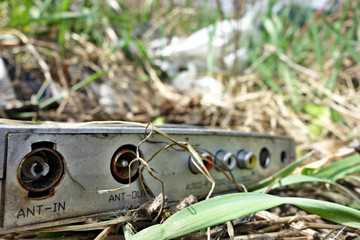
According to The Global E-waste Monitor, a report published by the United Nations University, the International Telecommunication Union and the International Solid Waste Association, humanity generated 44.7 million metric tons of e-waste in 2016, which is equivalent to 6.1 kilograms per person.
Just 20% of e-waste was properly recycled
in 2016. The vast majority (80%) was undocumented, likely to be dumped, traded
or recycled under inferior conditions. “The world’s e-waste problem continues
to grow. Improved measurement of e-waste is essential to set and monitor
targets, and identify policies,” commented Jakob Rhyner, Vice-Rector of the
United Nations University. “Existing global and regional estimates based on
production and trade statistics do not adequately cover the health and
environmental risks of unsafe treatment and disposal through incineration or
landfilling.”
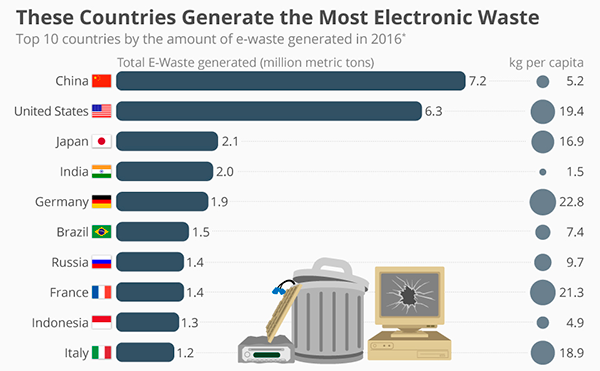
As this chart illustrates, China and the United States generated the highest amount of e-waste in 2016.
E-waste in Europe
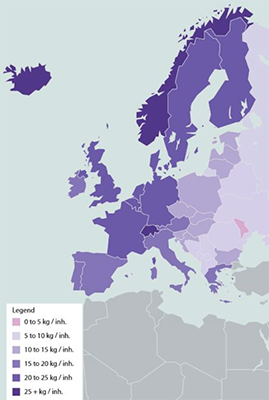
Although in terms of volume, the United
States and China, account for 32% of global electronic waste, are countries
such as Norway that have a higher ratio of electronic garbage per capita:
Norway generates 28.3 kilograms per inhabitant, Switzerland 26.3 kg and Iceland
26.3 kg.
Spain, on the other hand, generated 17.7 kilograms of electronic garbage per inhabitant in 2014; and other neighboring countries, such as Italy and France, generated 17.6 and 22.1 kilograms respectively.
E-waste in Spain
Spain is the fifth European country that
generates more “electronic scrap”, a total of 930,000 tons every
year, which means an average of 20 kilos per person, according to the Global
E-waste Monitor report of the United Nations University.
According to the study, this amount
represents an increase of 17% compared to the figures of four years ago and 43%
compared to eight years ago, so the volume of waste electrical and electronic
equipment has grown in Spain to a rhythm three times higher than the average
urban waste.
It is an alarming fact due to the
consequences that this type of waste can have for the environment and the
health of people. In addition, the forecasts suggest that this figure will
continue to grow in the coming years.
However, the report of Cetelem Observatory
on consumption in Spain in 2017, indicates that citizens are increasingly
“more aware” of the importance of making responsible use of these
electronic items, which already rank second among the most sustainable
products.
According to data provided by the Spanish Federation of Appliances Merchants, in the last year the recycling of electrical and electronic waste has increased, reaching 33,925,588 kilos.